“Loving My Mum Is Easy. Liking Her Is the Harder Part.”: What To Make of Your Complicated Relationship With Mum
Like Mother, Like Daughter
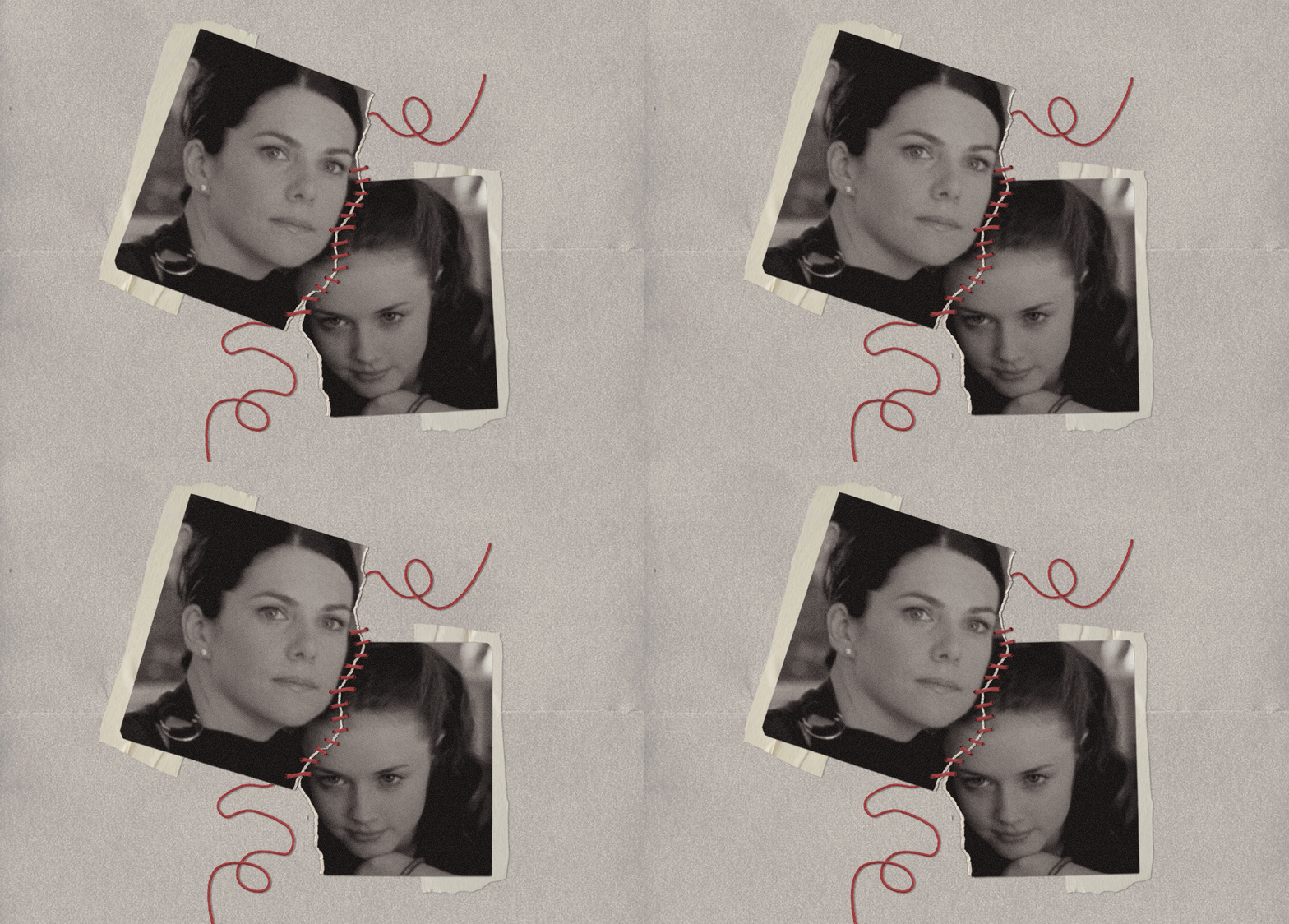

If you turn on any episode of Gilmore Girls, chances are that Lorelai and Emily are probably at odds over something. And if you’re tuning into the later seasons, Rory and Lorelai are no better off. Over the course of its seven-year run, the show explored the intricacies of mother-daughter relationships, laying out the good, the bad, and the ugly—often eliciting frustration in spades. Why does Emily immediately ruin every nice moment with Lorelai? Why can’t Lorelai just suck it up for one dinner? Does Lorelai realise that it’s kind of her fault that Rory is such a mess? Still, even over twenty years on, the show still feels relevant (and highly rewatchable).
Saoirse Ronan’s 2017 coming-of-age film, Lady Bird, is another film that resonates deeply, telling the story of a high school senior’s turbulent relationship with her mother. It’s beautifully shot with an incredibly talented cast, but what really earned the film its critical acclaim was the grounded, realistic portrayal of the strained mother-daughter dynamic. All this is to say that the troubled, tense connection between mother and daughter plays out on screen time and time again, from Freaky Friday to Everything, Everywhere All at Once. But why is the trope so gripping?
At its essence, it’s a dynamic many will recognise in their own relationships, particularly Malaysian women. The love between a mother and daughter is often never in question; but a real, deep, meaningful connection free of complications and messy feelings is another story. The struggle to cultivate a healthy maternal relationship is not an isolated one.
Ahead, we speak with Dr Siti Nordiana Dollah, Consultant Psychiatrist at The Kuaya, to unpack the origins of the toxic mother-daughter relationship trope, examine why it continues to thrive, and explore how one can move past it.
Part 1: Why are we fighting?

The crazy thing about your tense mother-daughter relationship is that you’re not the only one experiencing it, believe it or not! It’s far from a personal issue—rather, the strained mother-daughter relationship is, in large part, the result of a systemic social precedent shaped by perceived gender roles and expectations, intergenerational pressures, and family duty. In Malaysia, this precedent is all the more present, with family being a central source of identity, belonging, duty, and social reputation.
“Across many communities, daughters are often raised to be responsible, respectful, emotionally contained, helpful at home and sensitive to family needs. Mothers, meanwhile, are expected to carry the emotional and caregiving burden of the family, often while suppressing their own needs,” says Dr Nordiana. “Malaysian studies and commentaries also note that unpaid care work still falls heavily on women, and intergenerational duty remains a strong cultural expectation. So the tension often begins when love is expressed through control, sacrifice, correction or worry, rather than open emotional communication.”
She also explains that many mothers parent from a place of survival, fear, sacrifice, and social pressure, believing they are protecting their daughters by advising, criticising, warning, or setting strict expectations. And, as a result, many daughters, in turn, perceive this as judgment, lack of trust or emotional invalidation, and respond with exhaustion, identity struggle, and a strong need to be recognised as independent adults.
There is also, of course, the added layer of biology that contributes to the strain. For many, conflict tends to arise or intensify acutely during hormonally sensitive life stages—essentially, if puberty and menopause collide (which it all-too-often does), it spells trouble for any mother-daughter pair.
It also doesn’t help that mothers and daughters tend to mirror one another, intentionally or not. “A daughter may become the emotional extension of the mother: carrying expectations about womanhood, sacrifice, success, relationships, body image, motherhood, or family duty. At the same time, daughters naturally seek independence and identity formation. That tension between attachment and separation can create friction,” Dr Nordiana explains. “Mothers often see parts of themselves in their daughters. This includes unresolved fears, regrets, or unmet dreams. And daughters often measure themselves through the mother’s approval, even into adulthood.” What this looks like in real life is a relationship that is easily emotionally charged; where closeness feels like control, guidance like criticism, and where independence feels like rejection.
Part 2: Why are we still fighting?

You know how the saying goes: Time heals all wounds. In some cases (especially this one), it yields a scar etched deep. With the onus of family responsibility still largely falling on women culturally, it only makes sense that many tense mother-daughter dynamics persist well into decades (and beyond). This is particularly true in Malaysia, where it is common for children to remain closely connected with their parents well into adulthood, whether physically, financially, or emotionally.
Staying close to mum and dad builds strong family support and intergenerational closeness. However, the prolonged proximity can also blur emotional boundaries, especially if both the parent and the child do not allow their dynamic to mature or evolve.
Dr Nordiana explains this simply: “Parents may continue to see the adult child through a caregiving lens, while the adult child may struggle between autonomy and filial responsibility. This can create tension around decision-making, privacy, marriage, career choices, parenting styles, or even daily routines.”
For daughters in particular, there’s also an additional unspoken expectation to be emotionally available and accommodating, and that usually comes at the expense of building their own adult identity. Mothers, conversely, may experience difficulty letting go, particularly if much of their identity has revolved around caregiving. And there lies the issue: prolonged proximity may foster a love and closeness that coexists with guilt, emotional dependency, or frequent conflict.
“Clinically, the issue is usually not proximity itself, but whether the relationship can transition from parent and child to adult and adult, from control to guidance, and from obligation to mutual respect,” says Dr Nordiana. “Healthy interdependence can be protective and culturally meaningful. But when emotional boundaries do not mature alongside adulthood, prolonged closeness can increase emotional strain for both generations.”
Without intervention, this manifests in a few ways: love may be shown through practical care, but not emotional attunement; there will inevitably be difficulty discussing pain, disappointment, boundaries, or mental health openly; mothers may resort to repeating what they themselves inherited from their own mothers, resulting in daughters feeling responsible for the mother’s emotions, which in turn becomes a source of guilt. In short, it only gets more and more complicated from here.
Part 3: How do we break the cycle? How do we fix this?

At this point, the only way to really move forward is to either figure out how to mend things or cut your losses. But how does one know where to start? Well, it all begins with adjusting your expectations. According to Dr Nordiana, many adult children continue hoping for a version of the relationship that may never fully exist, while their parents may struggle to adapt to their child’s growing independence. In this case, repair isn’t about changing who you are as people, but rather changing the patterns of your interactions.
It’s easier said than done, but Dr Nordiana shares some helpful steps to explore, including approaching conversations with less blame and more clarity, learning to communicate needs calmly and directly, recognising generational differences in emotional expression, setting healthy boundaries without hostility, focusing on small, consistent changes rather than dramatic confrontations, and acknowledging that both sides may carry unspoken hurt, fear, or disappointment.
“It is also important to separate reconciliation from total agreement,” she elaborates. “A healthier relationship does not necessarily mean becoming emotionally close in every area. Sometimes progress simply means reducing conflict, increasing respect, or interacting more safely.”
However, there are also situations where distance is necessary, particularly if the relationship involves persistent emotional abuse, manipulation, humiliation, violence, severe boundary violations, or ongoing harm to one’s mental wellbeing despite repeated efforts to improve the dynamic. And, even then, cutting your losses should ideally come from a place of thoughtful reflection rather than anger alone.
It’s not a question of whether they are a bad parent or not; it’s assessing whether the relationship you have is repeatedly harmful, unsafe, emotionally damaging, or unable to improve despite efforts to reconcile. Dr Nordiana clarifies that this reframed thinking allows you to shift the focus from blame to impact, from labels to emotional safety, and from guilt to healthy boundaries and realistic decisions. It’s important to note that this does not mean that abuse should be excused. Instead, it means that the decisions you make should be based on the actual pattern and effect of the relationship, not only moral labels. “Sometimes healing means rebuilding closeness. Sometimes it means creating a healthier distance. Both can be acts of self-respect and maturity,” she concludes.
Dr Nordiana also suggests implementing THRIVE Parenting Tools when navigating difficult dynamics. “Many parent-child conflicts are not caused by lack of love, but by stress, exhaustion, unmet emotional needs, and difficulty communicating safely,” she says. “Navigating mother-daughter tension is often less about fixing the relationship and more about creating healthier emotional regulation, communication, and boundaries over time.”
Essentially, Dr Nordiana’s recommendation moving forward entails the following framework:
T is to Tune In and increase your emotional awareness. Pause before reacting. Notice stress, tone, body tension, sleep deprivation, or hormonal changes affecting the interaction.
H is to Hold Space, and to listen without correction. Sometimes children need emotional safety before advice. It’s key to learn to validate feelings without rushing to fix or judge.
R is to Regulate First. Calm the nervous system before difficult conversations and avoid major discussions when emotionally flooded, exhausted, hungry, or overwhelmed; regulation comes before resolution.
I is to Individualise Identity. You have to allow separation without guilt. Children growing differently from their parents is part of healthy identity development, not necessarily a rejection or disrespect. Parents may express love through advice, correction, or worry. Adult children can learn to recognise the intention without automatically absorbing the emotional pressure.
V is to Validate Vulnerability. Replace painful labels with curiosity. There is no “toxic mother”, “bad child”, or “ungrateful daughter”. Instead, ask “What pain or fear is underneath this behaviour?”
E is to Evolve Together. This means accepting that family roles must mature over time. Healthy relationships evolve from control to guidance and from dependency to mutual respect.
Obviously, everything here covers the general gist of things, but ultimately it’s up to you and mum to navigate the rough patches together. Beneath the tension, criticism, silence, or conflict, you and mum are both human, and chances are that you both long for the same thing: to feel loved, understood, respected, and emotionally safe with one another. It’ll take work and compromise to get there, but all you can do is your best. And with that, we wish you all the best.
For more culture stories like this, click here.
| SHARE THE STORY | |
| Explore More |