Exclusive: Edward Lee and Ryu Su Young Get ‘Mad About Seafood’
Journey of a lifetime
When someone mentions Korean cuisine, what normally comes to mind? If you thought of dishes such as bibimbap or BBQ, BBC’s travel docuseries will change all of that.
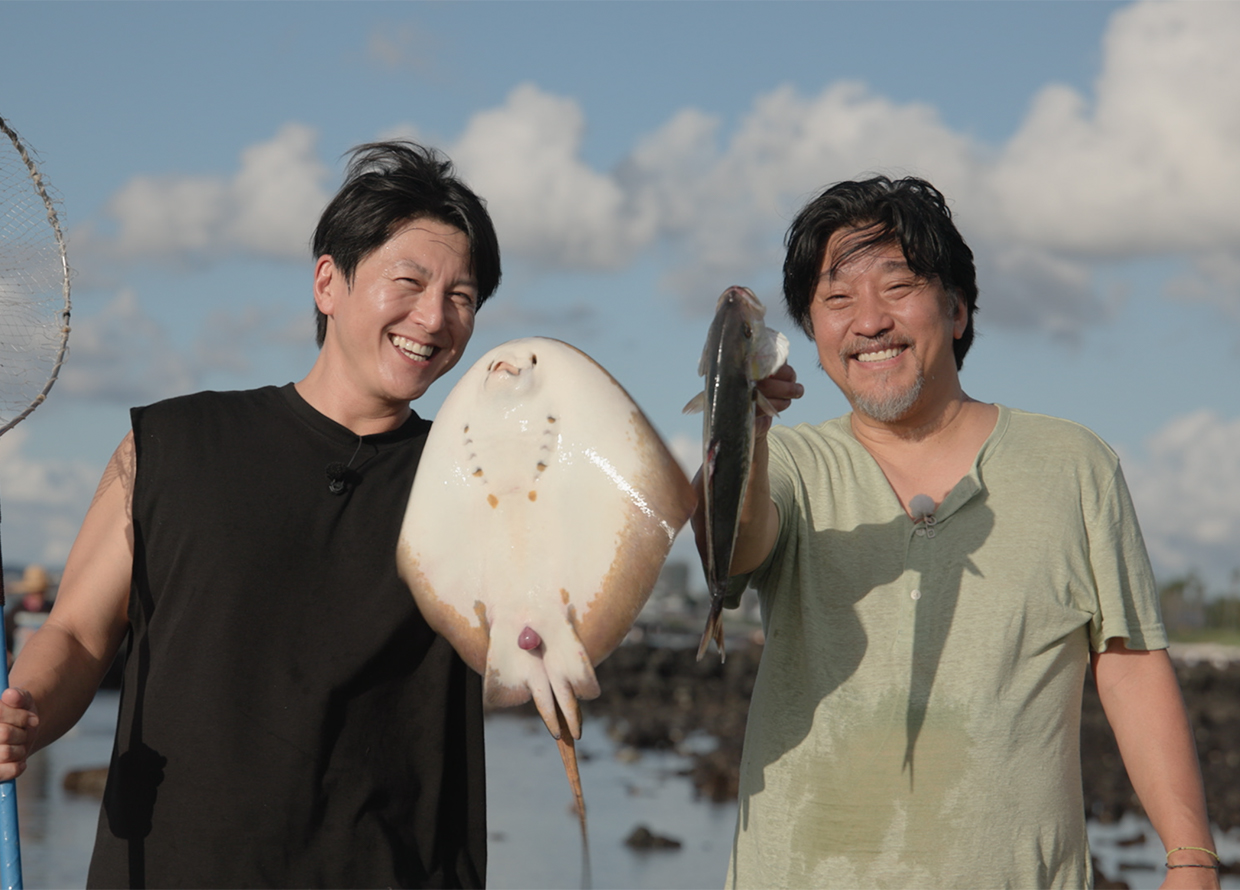
Hosted by acclaimed Korean-American chef Edward Lee (who captivated audiences on Netflix’s Culinary Class Wars) and South Korean actor and TV chef Ryu Su Young (KBS’ Stars’ Top Recipe at Fun-Staurant), Mad About Seafood takes viewers on a deep dive into Korea’s rich seafood heritage and maritime traditions.
Watch as Asian-American chef Lee reconnects with his Korean roots and deepens his knowledge of the country’s greatest coastal gems, regional customs, and history alongside beloved culinary personality Ryu, who may have encyclopedic knowledge of food but still finds new sides to his beloved homeland.
Ahead, we talk to Lee and Ryu about their sweeping journey along the South Korean coast for Mad About Seafood across four seasons, discovering new ingredients, and forging a bromance.
Neither of you has met before the show. What were your first impressions of each other?
Edward Lee (EL): I was shocked at how handsome he was! I watched Ryu’s show on Netflix, so I was familiar with his personality. For Mad About Seafood, he was very easy to work with and just has so much energy. That kind of energy is contagious, and we fed off of each other during the show. So, all in all, I was really proud and happy to work with him.

Ryu Su Young (RSY): I first watched him on Culinary Class Wars, and Mad About Seafood was my first time seeing him in person. I was very impressed with his personality and charm. Upon first meeting, he did look like a tough guy, but he’s actually very warm-hearted. I love this tough and soft side to him. [laughs]
Another thing that came across was how authentic he was throughout the whole show. I’m an entertainer and actor. Sometimes, we have to play up certain roles. But Edward isn’t an entertainer or a TV chef. He was just himself authentically. So, I think the way he acted naturally in front of the camera was really cool.

For a travel buddy show like this, the friendship element is very important. How would you describe your chemistry with each other?
EL: It was great because, as a Korean-American, I’m trying to discover and learn more about Korean food. For me, this programme was kind of an education. I’m almost like the audience in the sense that I’m discovering and tasting a lot of these foods for the first time.
Ryu was great because he was like my brother, who knew everything about Korean food—the history and the culture. So in many ways, he could explain to me what we were eating, why we were eating it, and the history behind it. That really made the experience special for me.

Sometimes, with fishermen and farmers, they do the work, but they don’t always see it from a philosophical or historical standpoint. But Ryu was able to consolidate all of that. Every time we went somewhere, he was able to put everything in context—the history of the region, the people, the culture, why this food is popular in this region, and so on.
As a result, I was able to learn so much from not just the farmers and fishermen but also from him. I’ve learned so much about Korean food and culture in this journey, so hopefully, the audience can feel that as well.

RSY: I do my best to let him know about Korean food and culture, but I don’t always get it right, you know! [laughs] It was a fun journey learning things together. Mad About Seafood is really a culinary exploration and expansion across four seasons.
We had a lot of meals together, which helped to build our chemistry. The word 식구 (shik gu) in Korean means ‘to eat together’. This act of eating together is very important in Korean culture because this is how we bond. We ate together so many times, and I just remember so much laughter and smiles during our meals. It was real chemistry between us.

Edward, audiences really admired your journey to reconnecting with your Korean roots in Culinary Class Wars. How has Mad About Seafood helped with that?
EL: When I come to South Korea, I mostly spend time in Seoul. I don’t get to travel out of there very often. For this series, we had experiences that I think very few people get to do—going fishing in the middle of the night, traversing mud flats, eating raw shrimp fished right out of the ocean. For me, whenever I think about seafood, I think about the people who devote their lives to catching these incredible marine creatures.

Sometimes, we would have the opportunity to meet these people and talk to them. In one instance, we went to Jeju Island to dive with the haenyeo, the great female divers. They have a very difficult life. It makes you stop and think what a privilege we have as chefs because there are these amazing people who spend their lives in the rough, wet, and cold outdoors to bring us these ingredients.

But they have a real connection to history and nature. Some of these people are fishing the same way that they did 100 years ago. To me, it was not only learning about seafood but also learning the history of Korea. You can read that in a book, or you can experience it in real life. When you do the latter, it’s a much deeper experience. These are memories I will have forever.

For Ryu, you’re no stranger to filming cooking shows. How is Mad About Seafood different?
RSY: In my cooking show, I share my original recipes for viewers. This time, I got to be more of a student instead of a teacher through Edward. I learned many things from him about cooking and how to appreciate ingredients. I’m good at teaching how to cook, but he taught me how to see the ingredients in a different, more precise way, such as their composition.

What were some experiences that stood out to you while filming Mad About Seafood?
EL: I still remember one food I discovered called eoram, which I think the closest way to describe it would be dried fish eggs like cod roe? In Italian, you would say bottarga, but it’s a totally different kind of method. I never had it before and tried it for the first time in the show. It’s so unique.
I’m a 53-year-old chef, and with my long career, I do get somewhat jaded because I feel like I’ve seen and eaten everything. So to try something that is brand new that I’ve never tasted before and made with such care and beauty was mindblowing. Even now, as I talk about it, I can still taste it in my mouth.

As a chef, I got so inspired. Now, I use it in my cuisine, and that’s something I really love because I get to discover something new even this far into my career. That was one experience that changed my whole brain chemistry.
RSY: I remember this dried squid dish! We met a grandmother in Jeonju, a famous city that is considered the capital of Korean cuisine in the Southern region. She had a nickname, ‘Master of the Scissors’. She made intricate shapes of a flower, dragon, and chicken out of dried squid!
These ornate dishes were used as decoration pieces to be displayed during marriages. I didn’t know that before, and it was an amazing experience to watch her work with a small pair of scissors and create these beautiful shapes with her hands.

How did this series change or redefine your perceptions about seafood culture in Korea?
EL: I think it’s a really important show. Korean food is getting more and more popular globally, especially in America right now. But here in the States, we still think of Korean food as BBQ or bibimbap. But actually, whenever I’m in Seoul, I’m eating a lot of seafood.
There’s so much Korean food that is based around seafood that is still unknown to the rest of the world. So this programme is important because it’s going to show how Koreans eat seafood, and its unique and diverse varieties.

Mad About Seafood literally changed how I think about Korean food. If you asked me two years ago what Korean cuisine is, I would say galbi, bulgogi and bibimbap. But now, if you ask me the same question, I immediately think of seafood. You have to realise, Korea is surrounded by water on three sides, so the culture of seafood and fishing is very important and ingrained here. There’s such a beautiful history behind it. It was just amazing to learn about it all.

RSY: I was born and raised in Seoul, South Korea, so not many things have changed in how I perceive Korean cuisine. But through the show, I realise I have to go to the real local areas to understand where the produce came from and, in turn, make better dishes.
Mad About Seafood is available to watch on BBC Earth and BBC Player.
For more ideas on what to watch, head here.
| SHARE THE STORY | |
| Explore More |